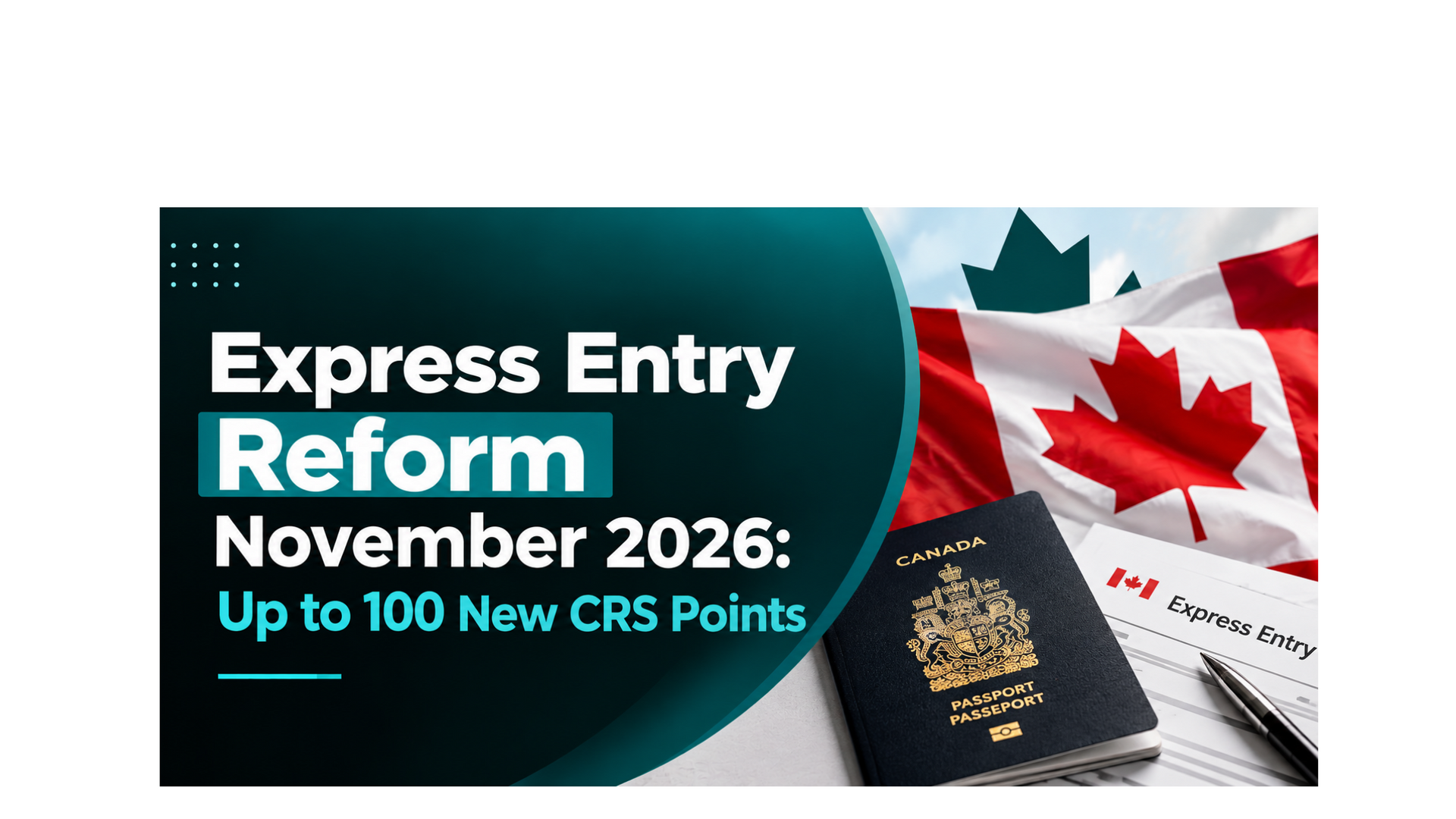
Express Entry 2026: Why CRS Scores Alone No Longer Guarantee PR
In 2026, Express Entry shifted away from pure CRS competition. Discover how category-based draws, employer demand, and regional needs now determine who receives permanent residence invitations.
Express Entry 2026: Why CRS No Longer Gets You Permanent Residence
For many years, Express Entry functioned like a points competition. Candidates focused almost entirely on increasing their Comprehensive Ranking System (CRS) score, believing that a higher number automatically meant a better chance at permanent residence. Language tests were retaken multiple times, education credentials were reassessed, and every possible point was chased.
In 2026, that reality has changed.
Express Entry is no longer a simple ranking system based on points. It has evolved into a skills-matching and workforce-planning tool. Today, thousands of candidates with CRS scores above 500 remain stuck in the pool without invitations, while others with scores in the low 400s are successfully receiving permanent residence. The difference is no longer points alone. The difference is alignment with Canada’s labour needs.
This shift is not accidental. It is part of a deliberate reset of Canada’s immigration strategy.
What Replaced CRS as the Primary Selection Method
CRS scores still exist, and they still matter. However, they no longer play the leading role they once did. In 2026, Immigration, Refugees and Citizenship Canada (IRCC) first filters candidates based on economic and labour priorities before CRS is even considered.
Profiles are now assessed through a workforce lens. IRCC looks at occupation categories, regional labour shortages, language requirements, and whether an employer or province has a demonstrated need for that skill set. Only after candidates meet these priority conditions does CRS ranking come into play within that smaller, targeted group.
This means Express Entry no longer asks, “Who has the highest score?” Instead, it asks, “Who does Canada need right now?”
Why Category-Based Selection Now Drives Express Entry
Category-based selection has become the backbone of Express Entry in 2026. More than seventy percent of invitations are now issued through targeted draws rather than general all-program rounds.
These draws focus on occupations and skills that are essential to Canada’s economy and public services. Healthcare professionals, skilled trades workers, transport and logistics employees, agricultural workers, STEM professionals, and French-speaking candidates are consistently prioritized.
By narrowing the pool to specific categories, IRCC removes competitiveness from unrelated profiles. A nurse is no longer competing against a marketing professional, and a tradesperson is not competing against a financial analyst. Each category is assessed based on its own urgency and demand, making the system more strategic and predictable.
Why Job Alignment Matters More Than High CRS Scores
One of the most important realities of Express Entry 2026 is that job alignment now outweighs raw points.
A candidate with a CRS score of 420 who works in healthcare, has relevant Canadian experience, and holds a job in Alberta may have a far stronger chance of permanent residence than a candidate with a CRS score of 510 who has no job offer and no connection to a priority sector.
This reflects Canada’s workforce-first approach. Immigration is no longer just about selecting the strongest individual profile on paper. It is about selecting candidates who can immediately contribute to the economy, support public services, and settle successfully in regions that need them most.
Who Is Most Competitive Under Express Entry 2026
Candidates who succeed under the current system tend to share common characteristics. They work in sectors that Canada has clearly identified as priorities. Many have Canadian work experience or a valid job offer from a Canadian employer. Others show flexibility by being open to living and working outside major cities, particularly in regional or provincial communities facing labour shortages.
In this new system, adaptability and relevance matter more than perfection. Being useful to Canada’s economic goals now carries more weight than achieving an exceptionally high CRS score.
Common Challenges and Practical Solutions
One of the most common frustrations in 2026 is being a high-scoring candidate with no invitation. Many individuals assume something is wrong with their profile, when in reality, the issue is strategic, not technical.
The solution is no longer limited to increasing CRS points. Instead, candidates must add an employer-driven or provincial strategy to their immigration plan. Securing a job offer, aligning with a provincial nominee stream, or repositioning experience to match priority categories can significantly improve outcomes.
Conclusion
Express Entry 2026 is no longer about being the strongest candidate on paper. It is about being the most relevant candidate for Canada’s present and future needs.
Understanding this shift is essential for anyone serious about permanent residence. CRS scores still matter, but they are no longer the deciding factor. Strategy, alignment, and real-world demand now define success.